
How Do You Live Inside Your Body? - A personal introduction to Rolfing


Two years ago, I completed one of the most intense journeys of my life: the Rolfing training.
Living in the Netherlands, studying in São Paulo and Munich during the pandemic, never knowing what would come next. So much uncertainty, so many fears... More than a professional training, it was a healing journey, in so many aspects.
Two years later, I feel glad and grateful for this journey. I'm also aware of the fact that working with Rolfing comes with a particular challenge: most people simply haven't heard of it yet. I also can easily understand when people ask me with a mix of curiosity and confusion:
"But what exactly is Rolfing? Is it like a massage? Some kind of physiotherapy?"
It's a fair question and, I'll admit, not easy to answer in a quick conversation. But the confusion usually clears when I answer with a different question altogether:
How do you live inside your body?
The question Rolfing asks is not just 'where does it hurt', but: 'How does it feel to inhabit your own body?' 'Is there room to breathe, to move, to rest?' 'Or does your body feel more like loose parts — shoulders, neck, lower back... — that you have to carry around and try to accommodate?'"
These are the questions Rolfing starts with. And they are different questions from the ones massage or physiotherapy ask. The idea is not just to promote relaxation or to fix what is supposedly 'broken', but to integrate all the 'parts' into a whole that you can inhabit with comfort, with space and freedom to be who you truly are.
More Than You'd Expect...
Rolfing is a holistic approach that works with the body's soft tissues — especially the fascia, the connective tissue that wraps, connects and integrates every single system in your body. Through hands-on work and guided body awareness, it reorganizes posture and movement patterns, releasing the chronic tension stored in old habits and compensations.
But what surprises most people isn't just the physical relief, it's everything else: people who come in with burnout leave feeling calmer, more rested, more at home in themselves. People who come in with back pain leave with more emotional openness, more self-confidence, a greater capacity to express what they feel...
The body and the inner life are not separate things, and Rolfing honors that.
It's not unusual to hear people say Rolfing is life-changing. In fact, most Rolfers — myself included — came to this work because of the transformation they experienced in their own bodies and lives, long before they ever thought of making it a career.
A Vision Ahead of Its Time
None of this would exist without a woman who was herself ahead of her time: Ida Rolf. Her dream was not to treat symptoms or fix diseases, but to promote health itself, helping the body find its own organization and ease:
"This is the gospel of Rolfing: when the body gets working appropriately, the force of gravity can flow through. Then, spontaneously, the body heals itself." (Ida P. Rolf)
Ida Rolf was the first person in the world to recognize the central role of fascia — decades before science caught up with her. The more research advances in this field, the more her vision proves to have been right...
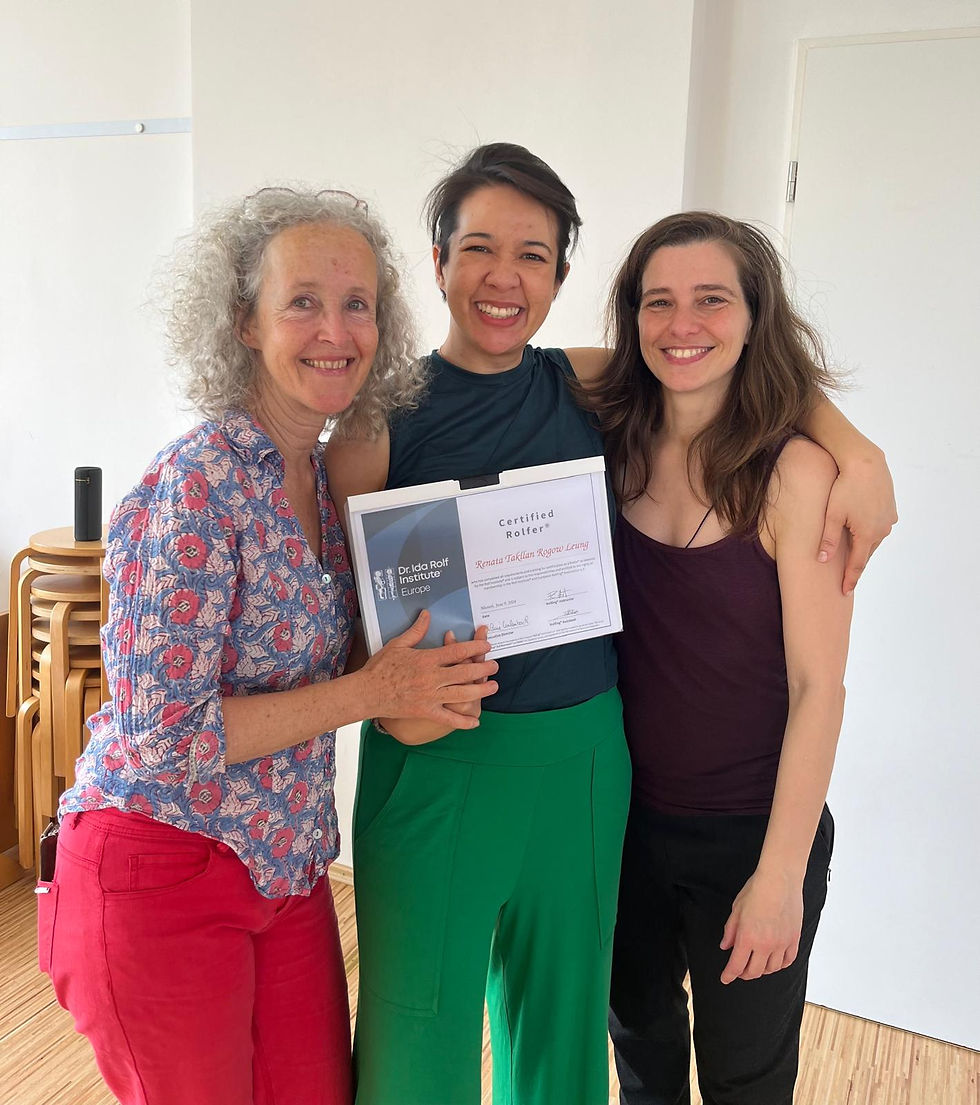
So here I am: two years after graduating, grateful for this path, and glad to share it with anyone curious enough to ask: what would it feel like to finally feel at home in my own body?
Have you ever had a Rolfing session, or have you been curious about it for a while? I'd love to hear your experience or your questions in the comments. You can also reach out for a free 20-minute call: visit the Contact page to get in touch. And if you know someone who might benefit from reading this, feel free to share. Some discoveries are better when made together.🌿


Comments